Wednesday, March 3, 2010

Mixing On Computer Speakers - The New NS10?

I'm sure you've heard of people doing it. I'm sure you might have even thought it was a stupid idea. Maybe you've seen people claim they have the "perfect set" of speakers...so flat you could sear a burger on their frequency response. Yeah, whatever. There are some great monitors out there for mixing and mastering, but who in the world other than engineers actually listen on those? Nobody! No. Body. What are they listening on? In the industry, it's commonly described as a "consumer speaker," or "real world reference speaker."

Does that mean all "consumer speakers" are crap? Of course not. In fact, they're getting pretty good these days for pretty cheap. However, it would probably be a safe guess to say that 90% of people are still listening to music on these four things:

1. Car.
2. Stereo system.
3. Ipod Headphones.
4. Computer Speakers.


To be honest, that's where I listen to most of my music, except I have a good car system, a good stereo, studio grade headphones, and mixing mains. However, people like you and I have to break out of our boxes and realize that most people don't have speakers with NEARLY that accuracy or precision. That can help us to some degree, because many people won't hear some of the bad-sounding details in the music that drive us crazy. However, the situation is twofold--those same people might not ever hear the really subtle good-sounding details we added.

Generally though, these speakers share certain characteristics. They may or may not have a limited frequency response, their accuracy is probably somewhat diminished due to cheap parts and design, and their overall projection is most likely mediocre.

Seems like most headphones claim to be around 20-20khz, even if they aren't. They don't show you a response curve...so that might mean that the headphones put out about -42dB at 50Hz, but it's there, so it counts, right? Eh....whatever. Stereo systems range from tiny Ipod Docks to $20,000 home entertainment systems. It seems like the main characteristic shared with these is that they are played loudly and have a low of low end. People like to pump up the bass. Computer speakers often have a response around 70Hz-15kHz. That seems to be the most popular range I see, but sometimes even something like 100hz-12khz. Ipod headphones have a fairly nice frequency response, but certainly not accurate, and in fact usually accentuate highs and lows, and ipods also have EQ functions (Which sound awful by the way...they're all active and they can distort the headphones very easily! Come on Apple...make a passive EQ.)

Maybe you're saying at this point "WHO CARES. WHY ARE YOU TALKING ABOUT THIS, KENDAL?" Well I was just about to explain!

It's important for us to check mixes...and perhaps completely mix...on some or all of these systems. It's a fascinating experince to do an entire mix on a set of computer speakers. Just try it. Try to make it sound as good as possible on these computer speakers. Notice what you have to do. Notice what things you have to change. After you do the mix on a set of small speakers, turn it back to your mains to adjust lows (below 100Hz) and highs (above 12k) just so you really have a good idea of what's going on in those ranges, making sure not to add too much in each.

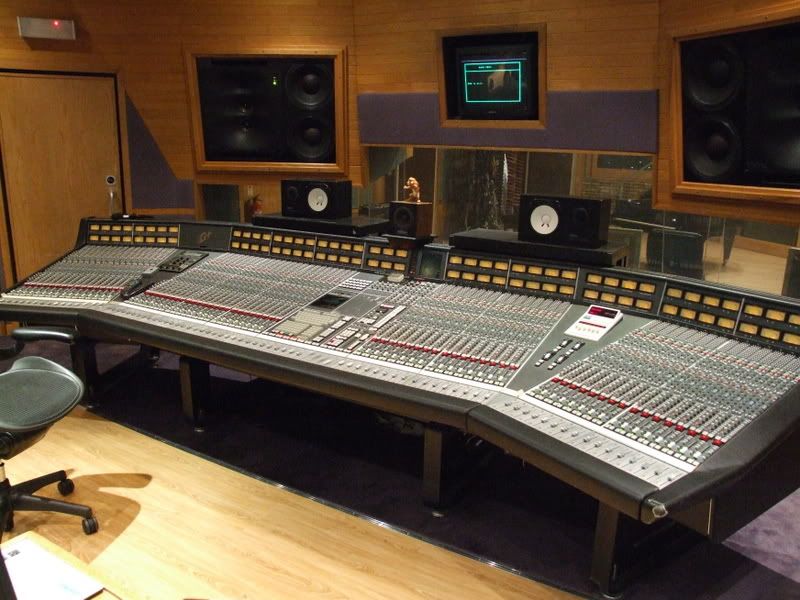
I'm sure you've also heard of the Yamaha NS-10 speakers. These little things are infamous. You have probably seen them on so many console meter bridges in pictures of professional studios around the globe. Here are some sample pictures.

 
    (an old NS10 spec sheet)

These monitors were originally supposed to be consumer speakers. They were made for use with stereo systems, as they originally had the wire jacks in the back like your old stereo system from your childhood. So how in the world did these things become so popular? I see these go on ebay for $600/pair, and since they're passive, that doesn't even include your power amp! What the heck! They used to be dirt cheap and sold at electronics stores! 

Regardless of your opinion, the facts are shocking. Why were they so popular? Well they had a pretty dominant midrange with some smeared low end and a weak top end. When mixed on these quietly, it allowed engineers to focus ONLY on the midrange, so they weren't being biased by lows and highs. As you can see from the frequency response, they only go down to 60, and even there is a pretty sharp rolloff. The top says it goes to 20k, but as you can see from the graph, there is a slight rolloff there starting from maybe 12 or 14k. Hm...what does that sound like?

Computer speakers perhaps? Maybe.

The idea is right. The old phrase "if it'll sound good on NS10's, it'll sound good anywhere," has gained immense popularity since the birth of these monitors. In my book, the phrase should go "if it sounds good everywhere, why does it matter what speakers you used to get there?" The point is, it doesn't. It is foolish of people to pay $600 + $400 amp for these speakers USED on EBAY beat up and probably broken. The woofers are PAPER. Seriously. They're about the thickness of a credit card in paper. They're not high quality speakers, folks. They're not really for details, they're for REFERENCE mixing.

Many people swear by them. I like them. I've used a pair once and they seemed to do the trick. However. Let me present to you a simple alternative that will only take a bit of your time.


Introducing the "Cyber Acoustics 2012" computer speakers. "Twenty Twelves" has a nice ring, sort of like "N-S Tens," right? Anyway. These things cost about $15 and you can get them from Walmart. They aren't that great. I think their max output is around 10 or so watts and their frequency response is something like 85Hz - 18k, but down at 85 and up at 18k it's very weak. Truth be told, for audio engineers and mix engineers, they suck. Really bad. The only reason people write good reviews about these is because they are consumers that don't understand...it's not the speakers than sounds good...it's the professionally done music you listen to that sounds good!

HOWEVER. I challenge to two things. First, try to mix on them. Do the whole mix, make it sound as good as you can. You want to be able to hear the kick's upper register and the upper harmonics of the bass. You want it to sound as good as it can on these. Then switch to your mains and see how it sounds. 

My second challenge is this: listen to a well produced song on the speakers and hear how it sounds. A great example that I go by is Train's "Drops of Jupiter," which is a great rock song that won two Grammys, one for Best Rock Song and one for Best Arrangement. It sounds amazing as it was recorded at Ocean Way Nashville. Another great rock song to listen to is Third Eye Blind's "Never Let You Go." Listen to how good it still sounds on these little speakers. It may cause you to rethink their potential...or your skills!

Who knows. For you, it might sound like crap. Maybe for your genre it will. For me, however, it's been completely opposite. I find that any genre, any style, can benefit from mixing on these $15 speakers.


Ciao!

Monday, March 1, 2010


I just noticed this...but...did you ever notice how the Line 6 Pod looks like a butt? Yeah, it sounds like one, too.

Tuesday, February 16, 2010

Love is In the Air...and so is TONE

Hey all. Valentine's day has come and gone...what a waste of a holiday. I guess it DOES stimulate the economy, bringing in something like 12 billion dollars per year on this ONE day, but still, give me a break. All guys around the world are told to buy stuff for their girls, take them out to dinner, get necklaces, bracelets, cards, chocolate, flowers, whatever. What do women have to do? Look pretty. That's it! Don't get me wrong, I love my girlfriend, but this holiday is very expensive!

Anyway. New podcasts are coming this month. Hopefully two. I'm not sure what they are going to be about, but I've got a few options to choose from:

1. Drum Tuning
2. Drum Mixing (could easily take many episodes)
3. Electric Guitar Mixing
4. Compression

These are topics that have been on my mind a lot lately, and most all of you have struggled with them at one point or another, Especially compression. It seems like compression is a taboo subject for many people...they have this idea that it just "makes stuff louder" or it "turns up quiet parts and turns down loud parts." Yeah, those are both true, but it's kind of like saying "Preamps make stuff louder." There are so many things involved with compression; it has so many uses and applications, you can go CRAZY with infinitely changing settings. I'm leaning more towards this episode, but I also don't want it to be too overwhelming too fast. I don't have a large listener base yet, so maybe I'll wait until that happens.

More soon.

K

Tuesday, January 26, 2010

Drum Tone / New Episodes / Updates in Gear

Sorry for the delay folks...we're going to get up two or three new episodes very soon for Recording Lounge. We've got one coming for our FOURTH and final episode in the series about project studios, and then we've got one on SM57s and guitar amps. What we did was this: we recorded a DI track and reamped it through a tube amp. We then moved an SM57 around and recorded the differences in tone. Why? Well you always see shootouts between different mics. Most people have at least a 57, so we decided to do a shootout with ITSELF! Seeing what can you do with a 57 that best suits your tonal needs? We're going to show you!

Today I'd like to do a very thorough demonstration of how to get great drum sounds in a project studio environment. I'll start by giving a list of the most important factors to drum tone, and then we can go into what each entails. The following list is in order of most importance to least:

1. A great drummer.
2. A great arrangement.
3. Good drum tuning / maintenance.
4. A great space.
5. Good engineering (placement, number of mics)
6. Good mixing (compression, eq, gating, reverb, etc)
7. Preamp Choice / Mic Choice. Mic Choice.
8. The Drums/Shells themselves.

This can be verified by some of the seasoned drummers of our time and past generations. The quality of the drumkit is not nearly as important as the quality of the drummer tuning it. If you can't tune a drumkit, LEARN. It's an INVALUABLE skill that will save you plenty of headaches later. Let's go through these slowly.

1. A great drummer.

Having a great drummer is key to drum tone. Without this, your band will suffer. A drummer that can play in time, play when he is needed, be dynamic in stick rudiments and motions, be creative and different, use cymbals wisely (not always banging away on the china or crash, but using the RIDE!) and understanding how to make their drums sound great right from the source.

2. A great arrangement.

Having the drummer play a certain beat at a certain time can make a song sound COMPLETELY different. Imagine if Michael Jackson's "Billie Jean" had been played with a very complicated beat. Would it have been as popular as it was? Probably not. TASTE is so much more important than SPEED and COMPLEXITY.

3. Good drum tuning / Maintenance

Any good drummer should know how to tune his or her own drums. Any good engineer should know the same. It's an invaluable skill that you should have. Go to youtube and look up the videos from Bob Gatzen. He is the best instructor for drum tuning there is. He explains how to make your kit sound AMAZING from the source. His videos are priceless, yet, they're all free. Watch "Quick Tips" and all the drum tuning videos. The way you set up your kit, its orientation, your hoop selection and style, your stick selection, your snare wire selection, your head selection...it's EXTREMELY important to the drum sound.

4. A Good Space.

Having a good room for drumming is EXTREMELY important. Generally drums sound best when recorded in a room with nonparallel walls and a high ceiling (>10ft, usually somewhere around 15-25ft). This lets the drums really ring and have a certain fullness that we all love. When mics are placed closely, you can still get a very detailed sound, and you can always gate the mics to some extent later, but for most rock applications, a nice big room can be the ticket. If you're working in a smaller room (smaller than 15x15x10) it will probably be in your best interest to treat it deader (with good treatments...not foam crap...good high quality bass traps made of rigid fiberglass). You can add reverb later. In a room that small, the drums don't have enough room to develop and resonate freely, so it'd be better to control the reflections and tone rather than let it ring wild and sound muddy or boxy.

5. Good engineering (placement, number of mics)

Some of the best drum sounds on classic and modern records have been recorded with fewer than six mics. One of the most revered "drum tones" is that of John Bonham...the drummer from Led Zepplin. It's been said that Bonham's kit was recorded with three large diaphragm condenser mics (valve) in an amazing space. The clarity and depth of some of those sounds is amazing, and it's just three mics. That tells you what good engineering can do!

Some great drum sounds have been made with 2-6 microphones, which usually means 2 Overheads, 2 Room, Kick, Snare. The overheads capture the clarity and depth of the heads and stick attack. Toms and snare are all captured well on these mics. The warmth, depth, and ambience is captured by the room mics (usually placed no closer than 8-10ft from the snare). The kick and snare mics are extremely important as they are played more than probably any other drum.

6. Good mixing (compression, eq, gating, reverb, etc)

As you will hear in some of the clips to come, having good mixing techniques can really make the drums come alive. Creative and thoughtful use of compression, EQ, saturation, gating, reverb, etc, can bring the drums to life, adding punch and clarity to the kit, as well as controlling ring and rumble, plus sympathetic vibrations within the kit.

7. Preamp / Mic Choice.

Having high quality microphones is important. It'd be in your best interest to spend the MOST money on your overhead/room mics. I prefer Neumann KM184s for Overheads, AKG 414s for Room Mics, SM57 for snare, MD421 for toms, RE20 for Kick, SM81 for ride or hihat, and if I do add a mic on the snare resonant head, it'll be an SM57. For preamps I prefer Helios and API 500 series modules. It's in your best interest to use the SAME or SIMILAR preamps for one kit. As in, try to use ALL API or ALL Helios or ALL Presonus or ALL your Mixer for the drums. That will give you a great "pre-eq" if you will; the drums will all have the same preamp model, thus they will all sound similar initially.

8. The Drums themselves.

Ironically, the least important thing is probably the drums themselves. Obviously it's important to some degree but when compared to everything else, the shells are not that important. If you've got a crappy kit that has 5 lugs per tom, you probably should get a better drumset, but generally anything made decently can be made to sound amazing. Learn everything mentioned in point #3 and you can make your drums sound twice the price.


Thanks! Demos soon...

K

Monday, January 11, 2010

New Year, New Gear, New Information

Hey Everyone! If you're reading this, you survived the change between 2009 and 2010. Resolutions, kissing at midnight, Times Square, happiness, joy, regret, hope, et cetera. All of this reminds me of Y2K. What a joke, haha. People were canning food and buying storm / bomb shelters to be installed in their yards and all of this. Give me a break, you would think Bill Gates would be smart enough to just tell the PC Clocks to reset. He's smart enough to create Windows, why did they think everything was going to end? What a weird day that ways.

So what are my resolutions?

A) Lose some weight. Every winter the cooking kills me. I love home cooked meals, so I've got to make sure and keep myself healthy.

B) Get some new gear! I've got a lot of gear planned for this year. API stuff, some acoustic isolation materials, some instruments, and some other things.

C) Continue to do the RECORDING LOUNGE PODCAST and get people interested in recording, music, and audio!

D) Listen to some good albums, watch some good movies, have some good memories.

E) LEARN!


Stay tuned, folks. Soon will be two or three episodes of RLP for you to enjoy. ITunes is a great way to get people interested in the podcast, and I'm glad we have the ability to share this information on such a big market. I love technology.

Monday, December 28, 2009

REASONS WHY MUSIC QUALITY IS DECREASING RAPIDLY

This post was inspired by an e-Newsletter from my friend Mr. Walt Bowers, a local engineer and studio owner. He is also an instructor for the Broadcast and Sound Engineering program and Tulsa Technology Center, and a part time instructor at both Tulsa Community College and the University of Tulsa.


GEORGE MASSENBURG on DATA COMPRESSION, DISTORTION, CLICK, and MUSIC


DYNAMIC RANGE:


http://www.cdmasteringservices.com/dynamicrange.htm

ABUSE OF AUTO-TUNE


http://www.hometracked.com/2008/02/05/auto-tune-abuse-in-pop-music-10-examples/


Interesting! Because of these videos and articles, I decided to make a video describing what George Massenburg was talking about.

Sunday, December 27, 2009

Sidechain Gang - Sidechaining 101

SIDECHAINING is the topic for today. So what is it?

Sidechaining is this: taking a piece of one signal and using it to do something for another. Let's think of a few examples of what a sidechain can do.

1) A De-Esser. This is a compressor with a sidechain EQ. The sidechain EQ looks at the source and you can adjust which frequency to attenuate. The de-esser selecectively compresses ONLY the selected band(s), usually somewhere above 5khz, to remove the sibilance from some voices.

2) Realistic Reverb. You can trigger a reverbs using mulitple sidechain compressors, so that when your voice gets above oh let's say -25dBFS, your voice is sent to  a Small Room Reverb.  However, once your voice goes to -12dBFS, your voice is sent to a Large Room Reverb. Why is this realistic? When your are in a space, you can't really hear too much of the room partially because you are influenced by what you see, but also because of the actual loudness of a voice. When a singer sings loudly, however, the voice can travel all the way to the back of the room, allowing you to hear how big the space really is. You get this effect in small venues listening to singer-songwriters.

3) A Gate's "Listen" or "Key" function. What this does on a gate is only release the gate for signals of a given frequency range. This can help a lot when gating kick drums and toms because you can choose a lower frequency as a key input so that the snare drum (usually the loudest thing) doesn't trigger the gate. Just select your frequency range and the gate will stay quiet until something in that frequency range is hit above the threshold, but it will play back the full sound, not a filtered sound.

4) Kick / Bass Dynamics -
This is the CLASSIC example of sidechaining that we're going to deal with today. This is where the kick triggers a compressor to turn down the bass guitar every time the kick hits. Why? Well the kick drum and the bass both share a similar frequency spectrum. Both have a wide response, from sub lows to present highs. The problem is, these instruments often compete if not played well. There's a certain "married" sound that you get from a bassist and drummer playing together in the groove. It's undeniable; it sounds like they are perfectly on and the bass is locked in with the kick drum. This can create a really punchy and tight sound and should REALLY be used when you're having trouble hearing both kick and bass fully. I've made two tutorials to explain how to do it!

You will need:

1. A compressor plug with a key input function. N4 has this, but N3 and C4 do not. See below.
2. The video tutorials that I made!


A free vst compressor plugin (to engage key in, turn up "KeyVolume" to 0.0dB):


CLICK BELOW TO DOWNLOAD:
theclosetstudios.com/SidechainCompVST.zip

Here are the videos for you to enjoy! Best Viewed Maximized and in HD.


NUENDO 3 / CUBASE / OTHERS


NUENDO 4

Wednesday, December 23, 2009

Tempo and Time Signature Changes

TUTORIAL OF THE DAY:
How to change tempo and time signatures within Steinberg's Nuendo or Cubase.

1) Tempo Change

Let's say you've got a metal band in the studio. They're really hitting the drums hard, making it "heavy" and adding subdrops and other crazy hooligan stuff like that. Then they say "hey, so this verse is 180bpm but then the breakdown is like 60bpm. It's heavy." So how do you do that in mid song? If the drummer is good he is recording to a click, and if he wants that in his ear, how can you do this?

Another example (a little less bitter sounding example) is if a band has a ritardando toward the end of a song and they go into a second song by gradually slowing down the first until they're at the new tempo. HOW CAN I DO THIS KENDAL, you ask? I made a video to show you how.


2) Time Signature Change

Alright, so you're recording a jazz trio. Drummer comes in and says "hey man. This verse is in 17/4, but then it changes to 5/4 in the chorus, and 6/8 until the end. Can I get a click for all of those?" Before you freak out, just relax a bit. You can do this. I'll show you how in this video.

Sunday, December 20, 2009

Drum Mixing

So today I finally got a chance to try out my MOTU on a full drumkit. Two words come to mind: At last! I feel like I was finally able to get tones that I wanted. I was recording on a custom wrapped 80's TAMA Kit with DW snare and custom made Saluda cymbals. Very nice sounding kit considering its age and it's somewhat older heads. The kick drum has a really cool mirror head. The miking went as follows:

Overheads - (2) KM184's
Kick - RE20
Snare - SM57
Rack Tom - SM57
Floor Tom - MD421
Room Mics - (2) AKG 414's


So, only eight mics on this kit, but it sounds like FAR MORE than that! Sean is a talented drummer, and today we were just setting up the kit, letting it acclimate to the room, getting sounds, checking mic levels and positions, etc. We recorded a quick little beat to mix sounds and I suggested doing a driving rock beat, so we did. After mixing, the kid sounded UNGODLY to say the least. It was dirty and vicious. I know that this sound is due to three things in this order:

1) My MOTU Mod.
2) My KM184s as Overheads.
3) Sean.

In the following clip, you will hear the 100% Dry drum sounds. After that you will hear the drums after mixing. The file is 24bit WAV.

DRUMTESTS.WAV

I was so impressed with the sounds we got I just had to share them with you guys. Just think...do your drum sounds usually end up sounding like the first clip? If so, then you need some mixing knowledge! Email me with any questions you might have.

RECORDINGLOUNGEPODCAST@GMAIL.COM

Saturday, December 19, 2009

Black Lion Audio MOTU 24i/o Review

Alright, so here's the deal. I've been using a MOTU 24IO for quite some time. It's a nifty piece of equipment. No preamps, no effects, nothing that just wastes space, simply 24 TRS inputs and 24 TRS outputs. I use external preamps (API, UA, etc) and choose to go mixerless. With the 24IO, all of my routing can be done within the CueMix software mixer, which is just incredible. Here's a picture of the CueMix from the MOTU Website (um...attention...channel 7 is way too hot.)


Anyway. So I really love the MOTU and have had no problems with it other than one thing: the quality of conversion. I found that most all MOTU units sound like crap at 44.1kHz resolution, but really sound pretty great at 96k. What sucks is, who wants / needs to record at 96k all the time? It takes up over double the hard disk space and is twice as hard on your hard drive to record. Most sessions I do end up being 44.1 or 48k, so that's where I usually keep my clock set.

Still...I did some tests and found that the 44.1 really started to bother me. In comparison to the 96k, it sounded like I had a sock over the microphone at 44.1...it was that dark and muddy. Now, in a full mix after EQ and compression, the 44.1 always sounded okay, but it was never as crisp or as detailed or...something...that I wanted it to be. I couldn't really put my finger on it.

Soon I learned about a company called Black Lion Audio. They're based out of Chicago, IL and their basic service is as follows: take pro-grade gear (NOT top of the line...but widely used Lower-grade "Pro Studio" gear), replace the analog section, replace the clock, and you've got yourself one amazing interface. They mod all kinds of interfaces, such as the Digidesign 002, 003, and 192. They also mod the MOTU 24io, HD192, and I think a few others. Each mod is different, and for my particualar unit, the clock has to be external; the housing is already jam packed with electronics. So, I got the BLA "Microclock mkII," with my mod. Since they can't fit it in the chassis, they just knock off about $100 of the price to compensate for your trouble, which I found to be a pretty impressive deal.

Out the door, my Mod and Clock cost around $950. My MOTU cost $1400 brand new, so having a professional quality interface for a grand total of only $2350 is a STEAL. To get the same number of inputs and outputs from Apogee, you'd have to spend a good $10,000+. Plus, the MOTU 24io mod is one of the more expensive mods. Some really well known producers are using the BLA stuff...Butch Walker, Jay Ruston, plus artists like the Donnas, Dave Bazan, Weezer, and so many more. It's really impressive.

I scheduled the mod back in September, and my date was December 7th. This place is POPULAR. As of right now, their next available mod spot is in late February. Anyway, so I gave my downpayment (half up front) and I paid for the clock (which they sent immediately). When I got the clock I plugged it in and experienced an interesting change. The soundfield had more clarity and depth, with just a touch of brightness added. What was probably happening was a touch of darkness being removed because of clock accuracy. Anyway, I noticed just from listening to my Left and Right outs that I could hear a difference. It was subtle, but you really could hear it.

Months passed and the time for my mod FINALLY came! I shipped it on a Tuesday and got there Friday. My mod was scheduled for the following Monday, and it was finished a week and a day later. It was difficult being without my MOTU for two weeks, but I was sure it would be worth it. And OH YEAH it was.

I wire everything back up, hook up my BLA Microclock, start working with the unit, and immediately I can hear a big difference. There was a LOT more clarity in the spectrum, just more clarity in transients and especially in tonal balance. I was able to notice things like, oh the kick is too boxy or the bass is a bit too boomy. Things came together quicker in the mix and to my surprise it was extremely translatable! That was my favorite part. I usually mix on a handful of speakers, but I hate it when I get an awesome mix on one set and then it doesn't sound nealy as good on another set. I think that is a combination of things (that we don't have time to talk about right now) but I know the BLA Mod and Clock helped a TON.

And don't even get me started on how good it sounds once you record an entire SONG with it! My goodness! Imagine this for a second: your sound is only as good as the weakest link in your chain. Mine was my converters, for sure. Other than that I use great instruments, room treatment, mics, and preamps. So think: if your chain gets just 10% better because of the mod, and you've got a production of 40-60 tracks, then your production will theoretically sound 400-600% better. That sounds ridiculous at first, but trust me this mod will make you believe it. Things sounded SO crisp and real. Like I was sitting right there listening. It truly was the missing link in my sound that I always needed to get that "professional sound" that we all love. It's incredible!

The company is rock solid. They're honest, they're patient, they do amazing work, and they've got to be the nicest guys I've ever talked to. They really know their stuff and will sit there on the phone explaining everything they do and everything that goes into the mod until you run out of minutes on your cell phone. FIVE STARS for Black Lion Audio. GO check them out and see the inredible deals they provide.

www.blacklionaudio.com